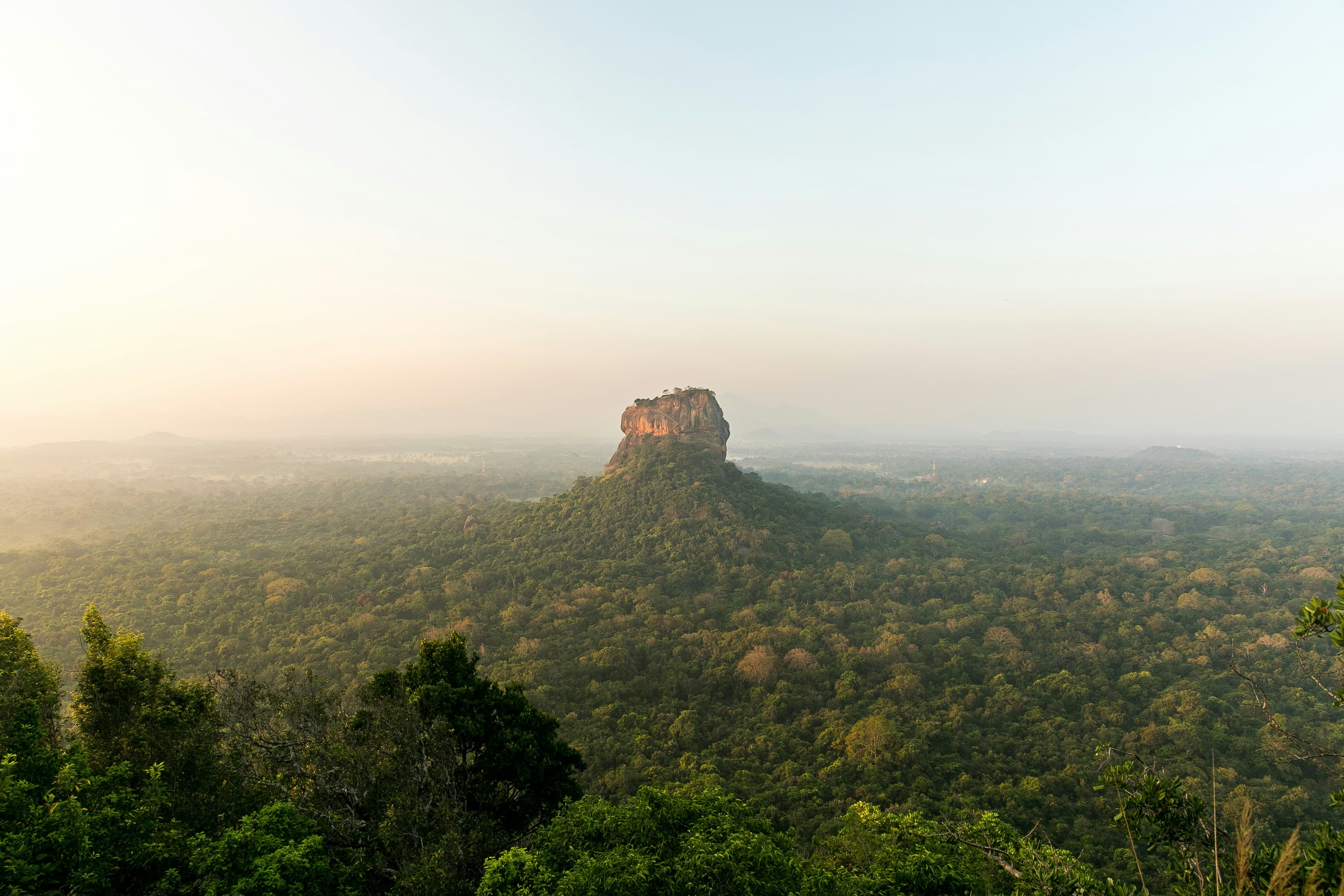
Cultural Triangle (Matale District)
Sigiriya
Sigiriya Lion Rock is a 5th-century palace fortress on a 180m granite monolith in central Sri Lanka. What the climb involves, when to go, how long it takes, and how it fits into a wider itinerary.
Sigiriya is a 5th-century rock fortress built on a 180-metre granite monolith in central Sri Lanka, and a UNESCO World Heritage Site. The climb is about 1,200 steps and takes 1.5 to 3 hours return. Go at opening or late afternoon — midday heat on exposed stairways is punishing.
| What it is | Rock fortress and royal palace ruins, 5th century CE |
|---|---|
| Status | UNESCO World Heritage Site (inscribed 1982) |
| Height | 180 m above the surrounding plain, roughly 349 m above sea level |
| The climb | About 1,200 steps; 1.5–3 hours return including stops |
| Best time of day | From opening (around 07:00) or after 15:00 |
| Difficulty | Moderate. Steep metal stairways, exposed sections, no shade near the top |
| Nearest town | Dambulla, about 20 minutes by road |
| From Colombo | Roughly 170 km, 4–5 hours by road |
About Sigiriya
Sigiriya is the single most recognisable image of Sri Lanka: a sheer orange-grey monolith rising 180 metres straight out of flat jungle, with the ruins of a royal citadel on top. King Kassapa built his palace up there in the 5th century, reportedly after seizing the throne from his father and fearing his brother's revenge. The paranoia produced one of the most extraordinary building projects in South Asia.
What survives is more than a view. The water gardens at the base are among the oldest landscaped gardens in the world and still work hydraulically during heavy rain. Halfway up, a sheltered gallery holds frescoes of bare-breasted female figures painted more than 1,500 years ago, their pigments still startlingly vivid. Beyond them runs the Mirror Wall, a polished surface covered in graffiti left by visitors between the 8th and 10th centuries — some of the earliest tourist reviews anywhere, and a genuine source for historians of the Sinhala language.
The final ascent passes between two enormous carved lion paws, all that remains of a gateway that once formed a full lion's head. Above them, the stairway is bolted to the rock face. The summit is a windswept plateau of brick foundations, cisterns cut into stone, and a 360-degree view over forest that stretches to the horizon.
What to see in Sigiriya
The frescoes
A spiral staircase leads to a sheltered pocket in the rock face holding 5th-century paintings of female figures. Photography is not permitted inside the gallery, and the guards enforce it.
The Mirror Wall
A polished plaster wall once reflective enough to serve as a mirror, now covered in verses scratched by visitors over a thousand years ago. Do not touch it — oils from skin are actively degrading what survives.
The Lion Staircase
Two colossal carved paws flank the final stairway. The rest of the lion — the whole head visitors once climbed through — collapsed centuries ago.
The water gardens
Symmetrical pools, fountains and moats at the base, engineered so precisely that some fountains still spout during the monsoon. Easy to rush past on the way to the climb, and worth not doing.
Pidurangala Rock
The neighbouring outcrop, a shorter and rougher scramble, with the best view of Sigiriya itself — because you are looking at it rather than standing on it. Popular at sunrise.
Best time to visit
Year-round. The Cultural Triangle sits in the dry zone and is far less affected by either monsoon than the coasts. January to March is driest and most comfortable; April to June is very hot. Whatever the month, climb early or late — the rock radiates heat and there is almost no shade above the frescoes.
Getting there
About 4–5 hours by road from Colombo or Bandaranaike International Airport, and roughly 3 hours from Kandy. There is no useful rail link; Habarana is the nearest station of any size. Most visitors arrive by private vehicle, which is how our tours handle it — the flexibility matters when you want to be at the gate at opening time.
How long to spend
Half a day for the climb itself. Two nights in the Sigiriya–Dambulla area lets you add Pidurangala at sunrise, the cave temples, and a Minneriya or Kaudulla safari without rushing.
What the climb is actually like
The route begins gently, through the water gardens and up broad stone terraces. It gets serious at the boulder field, where the steps narrow and steepen. From there a metal spiral staircase branches off to the fresco gallery, and the main path continues along a caged walkway bolted to the cliff.
The last section, above the lion paws, is the steepest: open metal stairs against the rock with a handrail and a long drop beside you. It is safe and well maintained, but if heights genuinely bother you, this is the part that will bother you. There is no alternative route to the top.
Reasonably fit visitors reach the summit in 45–60 minutes. Add time for the frescoes, for photographs, and for stopping in whatever shade you can find. Take more water than you think you need.
Sigiriya or Pidurangala?
This comes up constantly, and the honest answer is that they are not substitutes. Sigiriya is the archaeological site — the palace, the gardens, the frescoes, the history. Pidurangala is a rock next door with a superb view of Sigiriya and a fraction of the entry fee.
If you only have time or budget for one and you want the photograph, climb Pidurangala. If you came for the place itself, climb Sigiriya. Many of our guests do both: Pidurangala at sunrise, Sigiriya later that morning or the following day.
Be aware that Pidurangala is a rougher climb. The final stretch is an unmade boulder scramble with no handrails, and it is genuinely awkward in the dark or in flip-flops.
Tickets and practicalities
Entry is priced separately for foreign visitors and is one of the more expensive single sites in Sri Lanka — budget for it in the same bracket as Anuradhapura or Polonnaruwa. Fees are revised periodically, so confirm the current rate before you travel rather than relying on a figure in any article, including this one. On our tours, entry tickets to everything on your itinerary are already included in the daily rate.
Shoulders and knees should be covered at the site out of respect, and the summit gets windy. There are no refreshments beyond the entrance, and the toilets are at the base.
Wasps are a genuine, if occasional, hazard. Nests sit under overhangs on the rock face and the site closes sections when they become active. Signs ask for quiet in those stretches, and they are not decorative.
Frequently Asked Questions
- How long does it take to climb Sigiriya?
- Allow 1.5 to 3 hours return. The ascent takes most reasonably fit people 45–60 minutes, and you will want time at the frescoes, the Mirror Wall and the summit. Going at opening time or after 15:00 makes a substantial difference — the stairways are metal, exposed and unshaded.
- Is Sigiriya suitable for children or older travellers?
- Children who are steady on stairs generally manage it well and enjoy it. It is harder to recommend for anyone with knee problems, vertigo, or heart conditions — the upper section is steep open metal staircase with a significant drop. The water gardens and museum at the base are worth visiting on their own, so a group can split without anyone missing out entirely.
- Can you climb Sigiriya in the rain?
- The site stays open in light rain, but the steps become slippery and the summit view disappears into cloud. If a heavy downpour arrives while you are climbing, staff will sometimes hold visitors below the exposed sections. In practice this is rarely a problem — the Cultural Triangle is in the dry zone and sustained rain is uncommon.
- How much time do I need in Sigiriya overall?
- One full day covers the rock comfortably. Two nights in the area is the sweet spot, letting you add Pidurangala at sunrise, the Dambulla cave temples, and an afternoon elephant safari at Minneriya or Kaudulla without a rushed schedule.
- Is Sigiriya worth it given the entry fee?
- For most visitors, yes — it is the defining site of the Cultural Triangle and there is nothing else quite like it. If your interest is mainly the view rather than the archaeology, Pidurangala next door delivers a better photograph for a small fraction of the cost, and pairing the two is a common approach.
Tours that visit Sigiriya
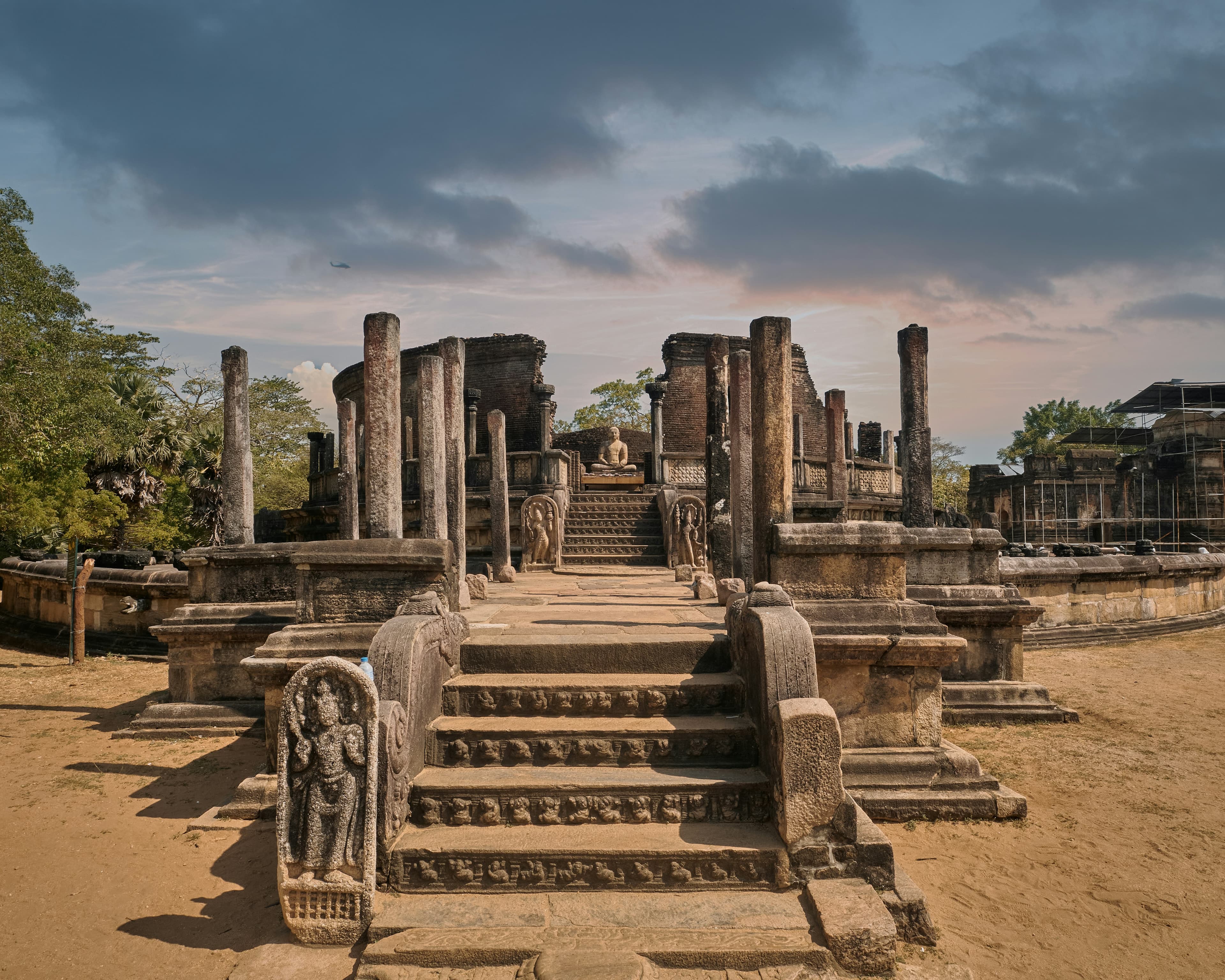
5 days · from $1,350
Classic Cultural Triangle Tour
A classic introduction to Sri Lanka’s rich cultural heritage. Visit the UNESCO ancient cities.
15 days · from $4,050
15 Days / 14 Nights Around Sri Lanka Tour
A comprehensive 15-day journey exploring ancient kingdoms, sacred sites, tea plantations, wildlife, and pristine beaches.

4 days · from $1,080
Short Sri Lanka Snapshot
For those with limited time, this tour hits the highlights: Culture, Heritage, and Coast.
Nearby destinations

Cultural Triangle (Matale District)
Dambulla
Dambulla Cave Temple is a complex of five caves cut into a granite outcrop in central Sri Lanka, holding 153 Buddha statues and roughly 2,100 square metres of painted ceilings. It is a UNESCO site and an active place of worship. Allow 1.5–2 hours, including the 10-minute climb.

North Central Province
Polonnaruwa
Polonnaruwa was Sri Lanka's medieval capital from the 11th to 13th centuries and is the best-preserved of the ancient cities. Its highlight is the Gal Vihara — four colossal Buddha figures carved from a single granite wall. The site is compact enough to cover in three to four hours, often by bicycle.

North Central Province
Anuradhapura
Anuradhapura was Sri Lanka's capital from the 4th century BCE to the 11th century CE and is the island's most sacred Buddhist city. It holds the Sri Maha Bodhi — grown from a cutting of the tree the Buddha sat under, planted in 288 BCE — and several enormous brick stupas. The site is vast; plan half to a full day.
Central Highlands
Kandy
Kandy is Sri Lanka's cultural capital and the last kingdom to fall to colonial rule, in 1815. It holds the Temple of the Sacred Tooth Relic (Sri Dalada Maligawa), the most important Buddhist shrine in the country. Most visitors spend one or two nights, timing a visit around one of the three daily puja ceremonies.