Eastern Province
Arugam Bay
Arugam Bay on the east coast is Sri Lanka's premier surf destination, with a world-class right-hand point break working from May to September. Breaks for every level, plus Kumana National Park nearby.
Arugam Bay on Sri Lanka's east coast is the country's best surf destination, centred on a right-hand point break that works from roughly May to September. Several breaks nearby suit all levels. Out of season it is very quiet — the swell and most of the businesses disappear.
| What it is | East coast surf town and bay |
|---|---|
| Season | Roughly May to September; peak July and August |
| Main Point | Right-hand point break, best at 3–6 ft, suits intermediate and up |
| Beginner breaks | Baby Point and Whiskey Point — gentler, sandy-bottomed |
| Out of season | Very quiet; little swell and many closures November–March |
| Nearby | Kumana National Park, Lahugala, Elephant Rock, Panama |
| From Colombo | About 320 km, 7–8 hours by road |
| From Ella | About 4 hours by road |
About Arugam Bay
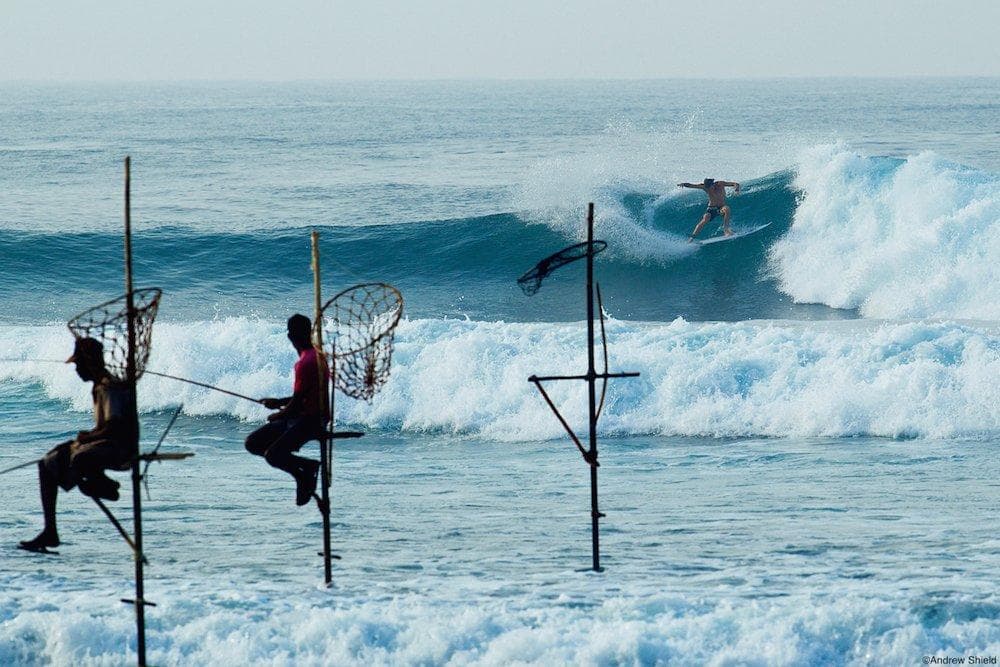
Arugam Bay runs on a different calendar from the rest of Sri Lanka. While the south and west coasts are being battered by the southwest monsoon between May and September, the east is dry, calm and — critically for surfers — receiving clean, consistent swell. Main Point, the right-hand break at the southern end of the bay, is regularly listed among the better point breaks in Asia.
The town itself is a single road running behind the beach, lined with surf shops, guesthouses and open-sided restaurants. It is relaxed, slightly ramshackle, and unmistakably a surf town — which is either the appeal or the reason to go elsewhere.
Outside the season it empties almost completely. Between roughly November and March the swell disappears, many businesses close, and the northeast monsoon brings rain. Visitors who arrive in January expecting the scene they read about find a very quiet beach.
What to see in Arugam Bay
Main Point
The break that made Arugam Bay's reputation — a long right-hander peeling over sand and rock, best at three to six feet. Crowded at dawn in peak season, and not a beginner wave.
Whiskey Point and Baby Point
Gentler, sandy-bottomed breaks a short tuk-tuk ride north, well suited to learners and longboards. Most surf schools teach here.
Elephant Rock
A break and a viewpoint about twenty minutes south, with a walk up the headland at sunset and, frequently, wild elephants on the approach road.
Kumana National Park
An hour south, and one of Sri Lanka's best birding sites — a mangrove lagoon system with large breeding colonies, plus elephants and occasional leopards.
Pottuvil Lagoon
A quiet mangrove lagoon reached by canoe, with wading birds, monitor lizards and, quite often, elephants at the edges in the late afternoon.
Best time to visit
May to September, without much qualification — that is when the swell arrives and the east coast is dry. July and August are the peak, and the busiest. From roughly November to March the northeast monsoon brings rain, the swell largely disappears, and a substantial proportion of guesthouses and restaurants close for the season.
Getting there
Roughly 7 to 8 hours by road from Colombo, and about 4 hours from Ella, which makes it a natural continuation from the hill country rather than a separate trip. The road from Ella through Wellawaya and Monaragala is scenic and passes close to several national parks.
How long to spend
Surfers usually stay a week or more. Three to four nights is enough for non-surfers or those combining it with Kumana and the lagoon.
Which break for which level
Main Point is the draw and is not the place to learn. It breaks over a rock and sand bottom, gets crowded in peak season, and the takeoff is steep enough to be intimidating on a bigger day. Intermediate and above.
Beginners head north to Baby Point and Whiskey Point, where the waves are smaller and the bottom is sand. Surf schools operate from both and lessons are inexpensive by international standards.
Peanut Farm and Okanda, further south, are quieter and worth the trip for stronger surfers looking to escape the Main Point crowd. Okanda sits at the edge of Kumana, and elephants on the road are a genuine consideration at dawn and dusk.
Fitting Arugam Bay into an itinerary
The east coast season is the inverse of the south and west. That makes Arugam Bay the answer to a common problem: what to do in Sri Lanka between May and September, when Mirissa and Galle are wet and rough.
A common route runs Cultural Triangle, then hill country, then east to Arugam Bay, rather than trying to force a south coast beach stay into the wrong months. Kalpitiya, on the north-west coast, is the other good monsoon-season option.
Wild elephants use the roads around Arugam Bay, Lahugala and Panama, particularly at dawn and dusk. Driving those roads at night is genuinely risky and we schedule around it.
Arugam Bay in pictures


Frequently Asked Questions
- When is the surf season in Arugam Bay?
- May to September, peaking in July and August. This is the inverse of the south and west coasts, which makes Arugam Bay the natural beach destination during the southwest monsoon. From November to March the swell disappears and many businesses close.
- Is Arugam Bay suitable for beginners?
- Yes, but not at Main Point, which breaks over rock and sand and gets crowded and steep. Beginners learn at Baby Point and Whiskey Point a short ride north, where the waves are smaller and the bottom is sand. Surf schools operate at both and lessons are cheap by international standards.
- Is Arugam Bay worth visiting if I do not surf?
- In season, yes — the beach is good, the town is relaxed, and Kumana National Park and Pottuvil Lagoon are genuinely excellent for wildlife and birds. Out of season there is not much reason to make the long drive, since the town largely closes.
- How do you get to Arugam Bay?
- About 7 to 8 hours by road from Colombo, or roughly 4 hours from Ella — which is why most itineraries reach it from the hill country rather than the capital. The road from Ella is scenic and passes several national parks.
Tours that visit Arugam Bay
10 days · from $2,700
Sun, Sand & Surf – Coastal Bliss
A relaxing 10-day tour exploring Sri Lanka's stunning southern coast, featuring surfing, beach relaxation, and vibrant nightlife.
6 days · from $1,620
Water Sports Adventure – Thrills & Waves
A 6-day high-energy tour designed for adventure seekers, featuring surfing, jet-skiing, kite surfing, and snorkeling along Sri Lanka’s best beaches.
Nearby destinations

Eastern Province
Trincomalee
Trincomalee on Sri Lanka's north-east coast has one of the largest natural harbours in the world, the Hindu temple of Koneswaram on a clifftop above it, and the calm white-sand beaches of Nilaveli and Uppuveli nearby. The season runs May to September — the inverse of the south coast.

Uva Province (Hill Country)
Ella
Ella is a small town in Sri Lanka's hill country at about 1,040 metres, known for the Nine Arches Bridge, short rewarding hikes up Little Adam's Peak and Ella Rock, and the scenic train line from Kandy. Two nights is the usual stay. Warmer and more relaxed than Nuwara Eliya.

Southern & Uva Provinces
Yala National Park
Yala National Park in south-east Sri Lanka has one of the highest densities of leopards anywhere in the world, alongside elephants, sloth bears and crocodiles. Block 1 is the most productive for leopard sightings and the busiest. February to July is the best period, when water is scarce and animals concentrate.