
Sabaragamuwa & Uva Provinces
Udawalawe National Park
Udawalawe holds several hundred resident elephants in open grassland, making sightings near-certain on any drive. Quieter than Yala and better for families. When to go and what else you will see.
Udawalawe National Park in southern Sri Lanka is the most reliable place in the country to see wild elephants — several hundred live there year-round in open grassland, and sightings on any drive are close to certain. It is calmer and less crowded than Yala, which makes it the better first safari.
| What it is | National park around the Udawalawe Reservoir, established 1972 |
|---|---|
| Famous for | Resident wild elephants — several hundred, visible year-round |
| Sighting odds | Elephants on essentially every drive |
| Also present | Water buffalo, spotted deer, crocodiles, jackals, 180+ bird species |
| Terrain | Open grassland and scrub — much better sightlines than forested parks |
| Crowding | Noticeably quieter than Yala |
| Nearby | Elephant Transit Home, a rehabilitation centre for orphaned calves |
| From Ella | About 2 hours by road |
About Udawalawe National Park
Udawalawe was created in the 1970s to protect the catchment of a new reservoir, and the resulting landscape — open grassland and scrub around a large body of water, with the hill country rising behind — happens to be near-perfect for watching elephants.
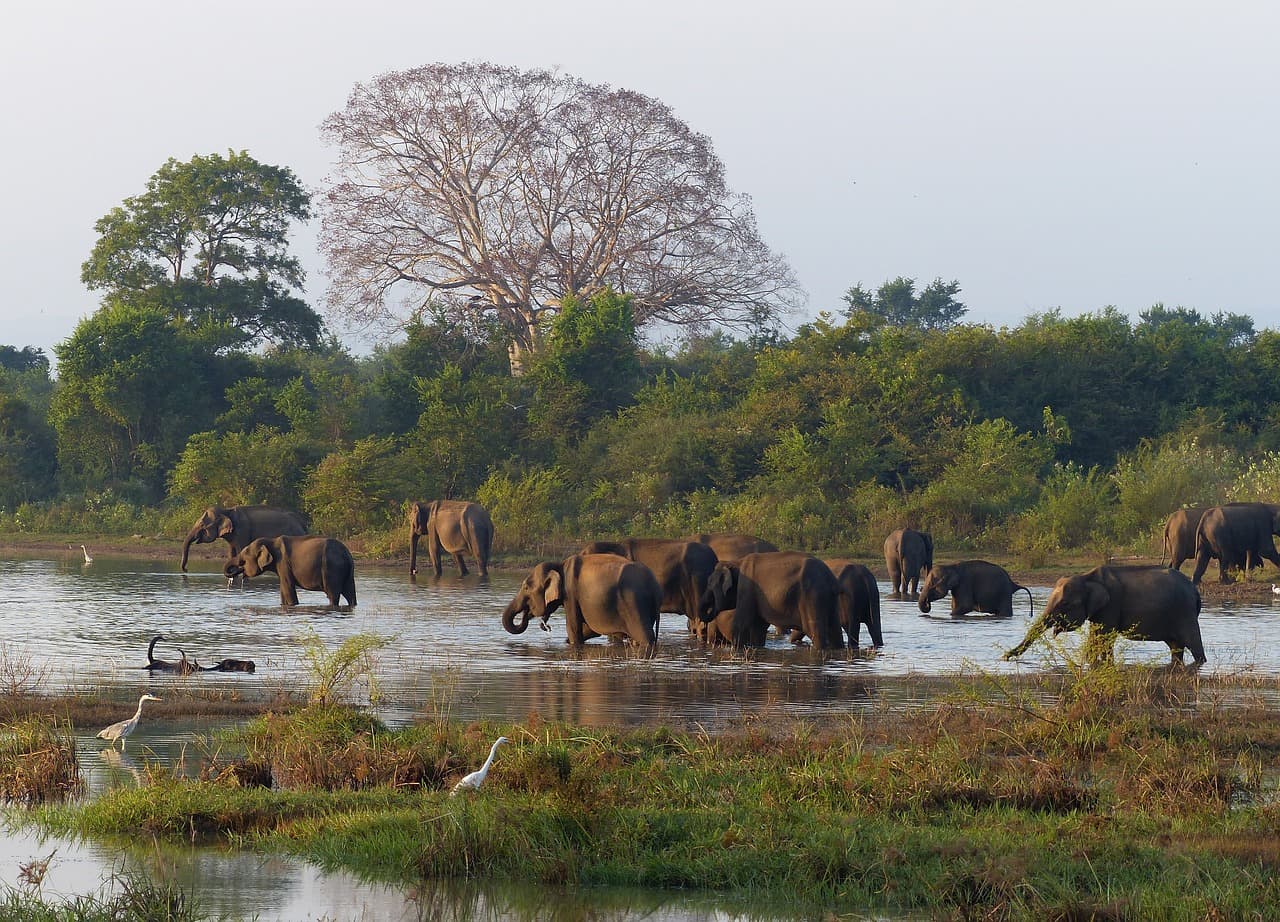
Several hundred live in the park permanently, and because the terrain is open rather than forested, you see them properly: whole family groups moving across grassland, calves under their mothers, bulls at the water. Guides will tell you sightings are guaranteed, and while nothing in wildlife is, this comes closer than anywhere else in Sri Lanka.
The park is also considerably quieter than Yala. Vehicle numbers are lower, drives feel less like a convoy, and the open sightlines mean you rarely need to be close to an animal to see it well. For families, nervous first-timers, or anyone who found Yala's jeep traffic dispiriting, Udawalawe is the better experience.
What to see in Udawalawe National Park
Elephant herds
Family groups of up to fifty crossing open grassland, often with very young calves. The open terrain means you watch natural behaviour at a respectful distance rather than glimpsing animals through scrub.
The reservoir
Elephants come to drink and bathe in the late afternoon, with the hill country as a backdrop. The best light and the best sightings usually coincide here.
Elephant Transit Home
A government facility just outside the park that raises orphaned calves for release back into the wild — a genuinely different model from the captive-elephant attractions elsewhere. Visitors watch feeding from a distance; there is no riding or bathing with animals.
Raptors
Crested serpent eagles, grey-headed fish eagles and changeable hawk-eagles are all common, and the open country makes them easy to spot.
Water buffalo and crocodiles
Both abundant around the reservoir edges, along with spotted deer, sambar and jackals.
Best time to visit
Year-round, which is part of the appeal — the elephants are resident rather than migratory. May to September is driest and animals gather more tightly around water. Early morning and late afternoon drives are best in any month; the middle of the day is hot and quiet.
Getting there
About 2 hours from Ella, 2.5 hours from Yala, and 4–5 hours from Colombo via the southern expressway. It sits conveniently between the hill country and the south coast, which makes it easy to include without a detour.
How long to spend
A half-day safari is enough to see the park properly. One night nearby lets you take an afternoon drive and visit the Elephant Transit Home the following morning.
Why Udawalawe suits families and first-timers
Sightings come quickly, which matters enormously with children — there is no long stretch of scanning empty scrub hoping something appears. Elephants are usually visible within the first twenty minutes.
The open terrain also means less bouncing along rough tracks in pursuit of a radio report, which is much of what a busy Yala morning involves. Drives are calmer and shorter, and the animals are large and easy for young children to spot themselves.
A note on elephant attractions
Sri Lanka has a number of places offering elephant rides, bathing, or close contact with captive animals. Welfare standards vary enormously and the practices involved in making a wild animal safe to ride are not ones most visitors would endorse if they saw them.
The Elephant Transit Home at Udawalawe works differently: orphaned calves are hand-reared with minimal human contact and released back into the wild, and visitors watch feeding from a viewing platform. There is no riding and no bathing. We recommend it, and we will not book elephant-riding experiences.
Udawalawe National Park in pictures

Frequently Asked Questions
- Are elephant sightings really guaranteed at Udawalawe?
- Close to it. Several hundred elephants live in the park permanently and the terrain is open grassland, so they are visible rather than hidden. Guides describe sightings as guaranteed; in practice they are as near-certain as wildlife watching gets anywhere.
- Is Udawalawe better than Yala?
- For elephants, for families, and for anyone who dislikes crowds — yes. Udawalawe is calmer, more open and far more reliable for the animals it is known for. Yala offers a genuine chance of a leopard and more varied landscape, but it is busier and its sightings are less certain.
- When is the best time to visit Udawalawe?
- Any month. The elephants are resident year-round, unlike the seasonal gatherings at Minneriya. May to September is driest and concentrates animals around the reservoir. Early morning and late afternoon are the best drive times in every season.
- Should I visit the Elephant Transit Home?
- It is worth an hour if you are already at the park. Orphaned calves are hand-reared for release back into the wild and visitors watch scheduled feedings from a platform — no riding, no bathing, minimal human contact. It is a markedly better model than the captive-elephant attractions found elsewhere in Sri Lanka.
Tours that visit Udawalawe National Park

10 days · from $2,700
The Great Wilderness – Wildlife Odyssey
A comprehensive 10-day wildlife expedition through Sri Lanka's top national parks, from Yala's leopards to Minneriya's elephants.
15 days · from $4,050
15 Days / 14 Nights Around Sri Lanka Tour
A comprehensive 15-day journey exploring ancient kingdoms, sacred sites, tea plantations, wildlife, and pristine beaches.

8 days · from $2,160
Birdwatching & Nature Specialist Tour
A nature-focused journey for birdwatchers, featuring Sri Lanka’s best wildlife reserves.
Nearby destinations

Southern & Uva Provinces
Yala National Park
Yala National Park in south-east Sri Lanka has one of the highest densities of leopards anywhere in the world, alongside elephants, sloth bears and crocodiles. Block 1 is the most productive for leopard sightings and the busiest. February to July is the best period, when water is scarce and animals concentrate.

Uva Province (Hill Country)
Ella
Ella is a small town in Sri Lanka's hill country at about 1,040 metres, known for the Nine Arches Bridge, short rewarding hikes up Little Adam's Peak and Ella Rock, and the scenic train line from Kandy. Two nights is the usual stay. Warmer and more relaxed than Nuwara Eliya.

Sabaragamuwa & Southern Provinces
Sinharaja Forest Reserve
Sinharaja Forest Reserve is Sri Lanka's last substantial stretch of primary lowland rainforest and a UNESCO World Heritage Site. It holds a majority of the island's endemic bird species and much of its endemic flora. Visits are on foot with a compulsory guide. Expect leeches, and bring socks.